
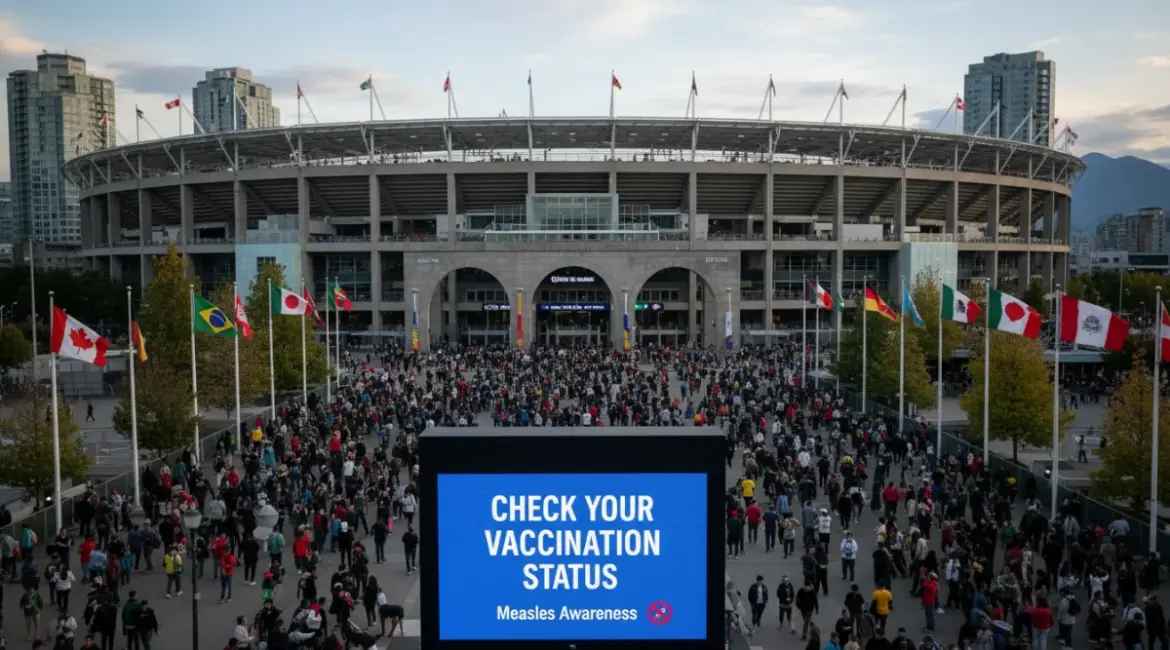
Public health officials are warning that the upcoming FIFA World Cup could bring a higher chance of measles reaching Canada, including Vancouver, as travelers from around the world arrive for the tournament.
The Public Health Agency of Canada has identified measles as one of the illnesses most likely to be imported during the event. The concern is straightforward: measles is still active in many countries, it spreads quickly through the air, and major sporting events put large groups of people in close contact for long periods of time.
Ontario has already released a detailed infectious disease risk review tied to the World Cup. That review points to international travel, crowded venues, and weaker vaccination coverage as factors that could make outbreaks more likely.
British Columbia has not yet made its own public risk assessment available.
Why Experts Want Clearer Messaging
Dr. Brian Conway, medical director of the Vancouver Infectious Diseases Centre, said the lack of visible public guidance in B.C. is a concern.
He said officials should be speaking more directly to both residents and visitors before large crowds begin arriving. In his view, people need to check whether they are protected against measles and get updated vaccinations if needed.
He also said travelers should understand that Canada is already dealing with active measles spread.
- Check your vaccination history before traveling.
- Make sure children and adults are fully immunized.
- Share simple health guidance with visitors coming to the city.
- Assume crowded events increase exposure risk.
His message is that preparation matters when a city is about to host thousands of fans, athletes, and tourists.
Cases Are Still Rising Across the Country
Canada has reported more than 900 measles cases across seven jurisdictions so far this year. Alberta and Manitoba have seen the largest share of infections.
This outbreak follows a much larger wave last year, when more than 5,000 people became infected. Health officials believe that surge began with a case in New Brunswick in fall 2024 after exposure outside Canada.
In British Columbia, provincial data shows 470 reported measles cases in 2025 and 2026. Roughly 80 percent of them were concentrated in northeastern B.C., where immunization rates are among the province’s lowest.
Vancouver Has Seen This Pattern Before
Experts are also looking at history for context.
After the Vancouver 2010 Winter Olympics, British Columbia recorded a measles outbreak that included 82 confirmed cases. The situation was different from today’s World Cup planning, but it showed how major international events can create conditions that help infectious diseases move.
Conway said the current risk is even more concerning because vaccination rates have fallen in parts of British Columbia. He also noted that some countries sending teams, staff, and fans may have lower vaccination coverage, which raises the odds that an infected traveler could arrive during the tournament.
What Health Authorities Say About Planning
Vancouver Coastal Health said it has been preparing for the FIFA World Cup for several years. The health authority said it has completed a public health risk assessment with the B.C. Centre for Disease Control, but the results have not been shared publicly.
Dr. Mark Lysyshyn, deputy chief medical health officer with Vancouver Coastal Health, said the measles risk during the tournament was rated in the medium or moderate range.
He said the region has already handled dozens of measles cases brought in from other countries during the current outbreak, and those cases did not lead to ongoing spread locally.
According to Lysyshyn, strong immunization coverage in the Vancouver Coastal Health region has helped stop transmission from spreading further. Because of that, he does not expect an imported World Cup case to be especially hard to manage.
Local Preparedness Is Already in Motion
The City of Vancouver says it has operational and emergency plans in place for the tournament.
City officials said they are ready to respond if any public health or safety issue comes up during the event.
That preparation is important because the World Cup will bring together a mix of visitors, workers, athletes, and local fans across multiple venues and public spaces.
Where the Greatest Risk Sits
Dr. Monika Naus, a professor at the University of British Columbia’s School of Population and Public Health, said large international gatherings always carry some infectious disease risk.
Still, she said the overall risk to most people remains limited because many adults are already protected through vaccination or past infection.
The bigger danger, she said, is measles reaching places where vaccination rates are low.
In British Columbia, the most vulnerable communities are often clustered together geographically and have lower immunization coverage than the surrounding population.
Why vaccination status matters now
Measles is highly contagious, but it is also preventable. Public health experts say checking records before the tournament is one of the simplest ways to reduce risk.
If more people are fully immunized, an imported case is less likely to become a larger outbreak. For Vancouver, the goal is to enjoy a major global sports event without giving a preventable disease room to spread.
Canada’s Elimination Status Is Gone for Now
The Public Health Agency of Canada said last year that the Pan American Health Organization informed Canada it no longer has measles elimination status.
That status is lost when transmission continues for a long stretch instead of remaining limited to isolated imported cases.
Canada can regain elimination status if transmission is interrupted for a full year.
The Bottom Line for Residents and Visitors
The World Cup will bring excitement, energy, and international attention to Vancouver. It will also bring extra health planning into focus.
For experts, the message is not panic. It is readiness.
Know your vaccination status, protect vulnerable communities, and make sure the city is prepared for the health risks that can come with a large global event.