
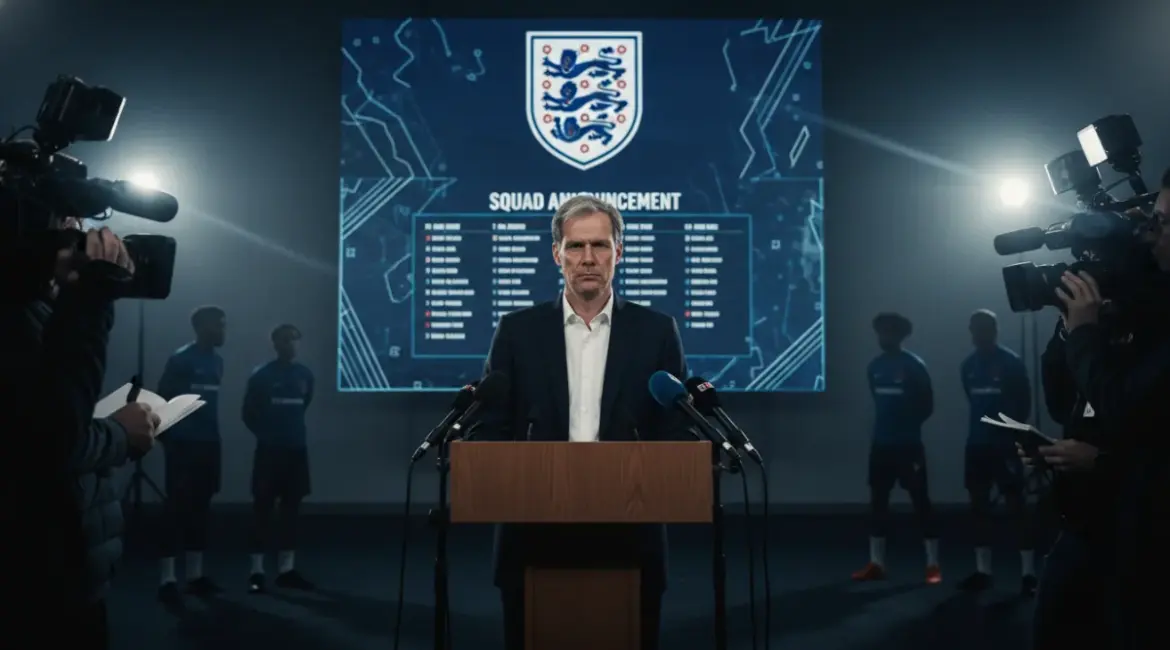
Thomas Tuchel has made his clearest statement yet as England manager, and it arrived with very little softness around the edges. His 26-man World Cup squad for North America is a mixture of trusted regulars, fresh energy, and a handful of choices that will dominate debate for days.
As Tuchel put it during the announcement, he enjoys the difficult calls. This one certainly lived up to that claim. Several well-known players were left out, and the reaction was immediate because the list contains both obvious logic and real surprises.
The biggest names to miss out
The most attention-grabbing absences are Cole Palmer, Phil Foden, Trent Alexander-Arnold, and Harry Maguire. Not long ago, each would have been viewed as close to a guaranteed inclusion, which is why their omission feels so striking.
Palmer and Foden stand out the most. Both had uneven club seasons, and Tuchel appeared to decide that England’s attacking depth gave him enough alternatives to move on without them. When the competition for places is this intense, even elite talent can be crowded out.
Alexander-Arnold’s absence is different, but no less notable. The Real Madrid fullback has not featured for England since last summer, and his lack of recent involvement reduced his momentum at exactly the wrong time.
Maguire, meanwhile, did not hide his frustration. He said he was shocked and disappointed to miss the cut, and his reaction reflected the scale of the surprise surrounding the final squad.
Why Tuchel backed continuity
Tuchel’s selection was not built on reputation alone. Much of his thinking was shaped by the international windows in September, October, and November, when England looked settled and balanced. That stability clearly mattered to him.
Rather than overhaul the group, he chose to protect the core that responded well during those camps. The message is simple: chemistry, clarity, and familiarity may matter more than one-off form in the build-up to a tournament.
He also made it clear that balance played a major role. In several areas, Tuchel did not want to carry too many players with the same skill set, especially if that would force someone to operate in an unfamiliar role.
Players who benefited from the selection call
Not every surprise was a negative one. Ivan Toney earned a recall and gives England a very different option in attack. Now at Al-Ahli in Saudi Arabia, he brings physical presence and a direct style that can change the shape of a game.
A number of younger or less established players also stayed in the picture, which reinforces Tuchel’s willingness to mix experience with upside. The final group includes players who have shown enough consistency to justify trust, even if they are still building their reputations at international level.
Key winners from the final squad
- Ivan Toney, for returning as an alternative striker
- Djed Spence, for maintaining his place in the mix
- Kobbie Mainoo, for continuing to earn international confidence
- Eberechi Eze, for adding creativity and versatility
- Jarell Quansah, for staying in the frame defensively
- Nico O’Reilly, for being trusted in a competitive pool
Other players left on the outside
Beyond the headline omissions, a few more names will feel hard done by. Morgan Gibbs-White, Adam Wharton, Lewis Hall, Luke Shaw, and Jarrod Bowen were all left out despite offering strong cases of their own.
That group underlines how ruthless the final stage of selection can become. Good performances were not enough on their own if Tuchel felt the squad needed a different balance, a different profile, or a more reliable fit in a specific position.
England’s full 26-man World Cup squad
Goalkeepers
Jordan Pickford, Dean Henderson, and James Trafford make up the goalkeeping group.
Defenders
Reece James, Ezri Konsa, Jarell Quansah, John Stones, Marc Guehi, Dan Burn, Nico O’Reilly, Djed Spence, and Tino Livramento are included in defense.
Midfielders
Declan Rice, Elliot Anderson, Kobbie Mainoo, Jordan Henderson, Morgan Rogers, Jude Bellingham, and Eberechi Eze form the midfield unit.
Forwards
Harry Kane, Ivan Toney, Ollie Watkins, Bukayo Saka, Marcus Rashford, Anthony Gordon, and Noni Madueke are the attacking options chosen by Tuchel.
What this squad says about England
This is not a cautious list, but it is a purposeful one. Tuchel has chosen continuity where he trusts it, speed where he values it, and flexibility where the tournament may demand it.
The risk, of course, is obvious: leaving out proven names invites scrutiny the moment England stumble. But the reward could be just as significant if the squad clicks quickly and the chosen mix proves more dependable than the names on paper that were left behind.
For now, Tuchel has taken full ownership of the decision. England’s World Cup story begins with a squad built on conviction, and that alone makes it one of the most talked-about selections in recent memory.