
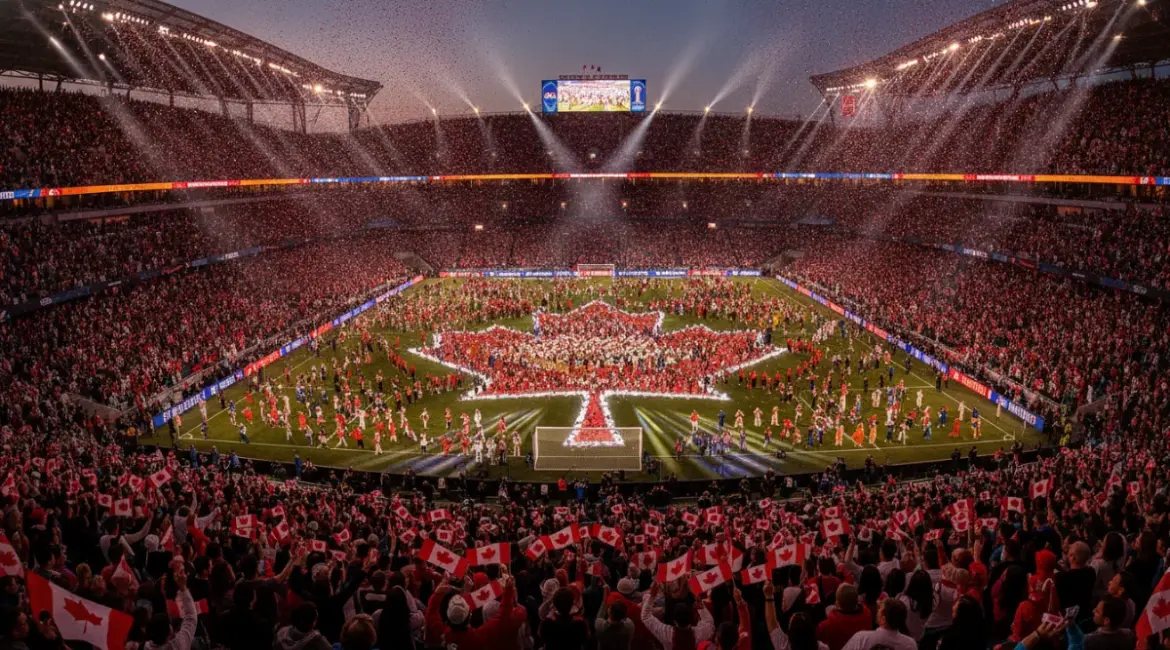
The 2026 FIFA World Cup opens with a landmark moment for Canada, which is hosting the tournament for the first time. The event begins across Canada, the United States, and Mexico, with the full competition running from June 11 to the final on July 19 in New York.
For Canadian supporters, the significance is hard to miss. The United States has hosted before, and Mexico has done so twice, but this is Canada’s debut as a World Cup host. The tournament will feature 104 matches in 16 cities, and Toronto will be one of the most closely watched venues.
What Toronto is preparing for
Canada’s opening ceremony takes place at Toronto Stadium on June 12 at 1:30 p.m. local time, which is 17:30 GMT. The short performance is built around the idea of a cultural mosaic and is designed to reflect Canada’s diversity through music, movement, and visual storytelling.
The show opens with a countdown framed as a journey “from coast to coast to coast,” a phrase that captures the country’s vast geography and national identity.
- Estimated runtime: about 13 minutes
- Theme: cultural mosaic
- Start time: 1:30 p.m. local time
- Location: Toronto Stadium
The planned lineup includes Canadian performers Alanis Morissette, Alessia Cara, Jessie Reyez, Michael Bublé, and William Prince, along with Elyanna, Nora Fatehi, Sanjoy, and Vegedream.
The match that follows
The ceremony leads directly into a historic moment for Canadian men’s soccer. Canada will play Bosnia and Herzegovina immediately afterward, marking the first World Cup match ever played on home soil by the men’s national team.
Kickoff is scheduled for 3 p.m. local time, or 19:00 GMT, after the pre-match buildup and player introductions. For the team and the crowd, the occasion carries more weight than a typical opening fixture.
FIFA President Gianni Infantino described the Toronto production as “a powerful reflection of Canada’s identity,” calling it a moment of pride and unity as the country steps onto the tournament’s biggest stage.
A three-country opening week
Canada’s ceremony is part of a shared launch across all three host nations. Each opening is tied together by the idea that football can connect people beyond borders, while each country still brings its own style to the presentation.
The productions are led by Marco Balich, who has worked on several major Olympic opening ceremonies.
- Canada’s presentation highlights its cultural mosaic
- Mexico’s show draws on papel picado, the traditional cut-paper art form
- The United States uses a bright, high-energy visual concept described as a “super shiny, glowing cup”
Mexico City opens the tournament on June 11 at Mexico City Stadium, the former Estadio Azteca, with its ceremony beginning 90 minutes before Mexico faces South Africa. That program is the longest of the three and is expected to feature Indigenous performers, folkloric elements, and stars such as Shakira, Alejandro Fernández, J Balvin, Maná, and Tyla.
Later on June 12, the United States stages its own ceremony at Los Angeles Stadium before facing Paraguay. That event includes Katy Perry, Future, Anitta, LISA, Rema, and Tyla.
How fans can watch
In Canada, coverage of the opening ceremonies and matches will air on CTV and TSN, with French-language coverage on RDS.
For viewers elsewhere, the U.S. broadcast lineup includes FOX, FS1, and Tubi, while audiences in the United Kingdom can watch through the BBC and ITV.
Why this matters now
Toronto is preparing for a large influx of visitors, and organizers are adding transit support and planning around stadium-area congestion. Security and logistics are major priorities across all three host countries as the tournament begins.
There have also been local complications in other host cities. In Mexico City, teacher protests have raised concerns about possible road disruptions, though officials say the opening event is secure. In Los Angeles, authorities have focused on crowd control and have said they do not expect immigration enforcement at World Cup venues.
For Canada, the day is bigger than a ceremony. It is a national first, a home match on the world’s largest stage, and a chance for Toronto to show what the country’s soccer moment looks like in front of a global audience.