
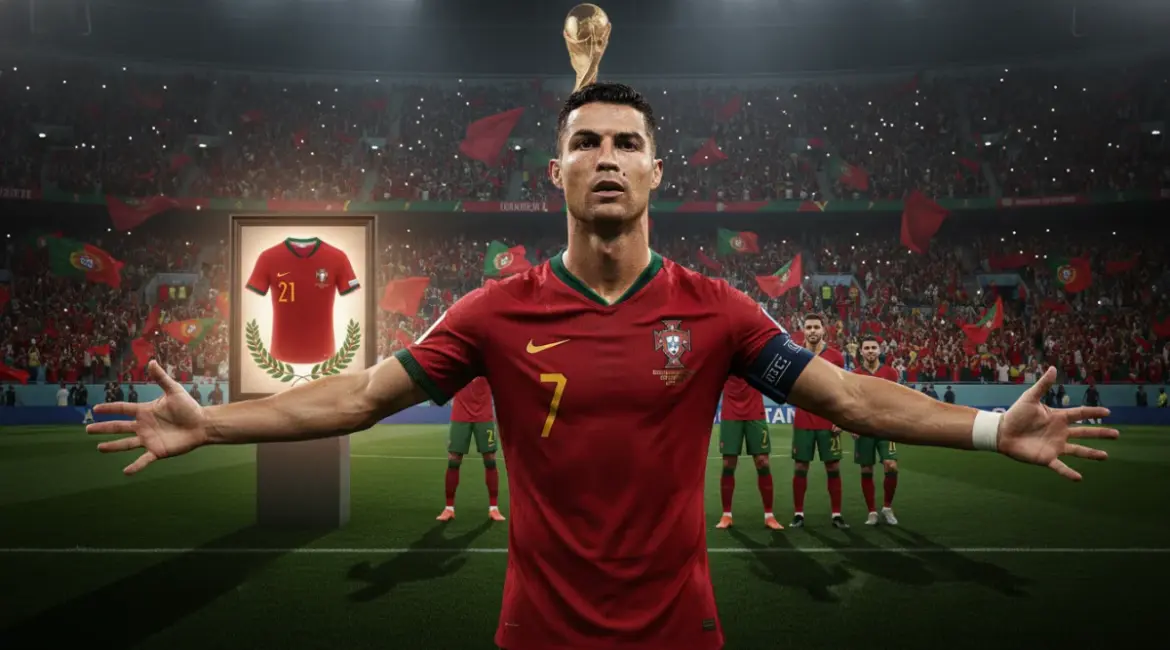
Portugal has entered the tournament picture with a squad that feels bigger than football. Roberto Martínez has named a team built to compete at the highest level, while also carrying the memory of Diogo Jota as a lasting part of the journey. At the center of it all stands Cristiano Ronaldo, still chasing another historic milestone in a career already packed with records.
The announcement was not just a list of names. It was a statement about ambition, continuity, and emotion. Portugal believes it has the depth to challenge anyone, but it will do so with a clear reminder of the teammate it lost and the standards its leaders are expected to uphold.
Ronaldo’s Next Milestone Could Make More History
Cristiano Ronaldo remains the most recognizable figure in Portugal’s setup. At 41, he is still being selected for more than sentiment. Martínez continues to value his finishing ability, competitive drive, and influence in a dressing room full of elite talent.
If Ronaldo appears in the tournament, he will move into a truly rare category: one of the first male players to feature in six World Cups. Lionel Messi could join him in that company if he also takes part for Argentina.
Records Ronaldo Already Owns
- Most goals in men’s international football
- Most appearances in men’s international football
- Only male player to score in five separate World Cups
- One of the defining figures of modern Portuguese football
That record book matters, but so does the message his selection sends. Portugal is not treating this as a farewell tour. The coaching staff sees him as a central piece of its plan, especially in tight matches where one decisive moment can change everything.
Diogo Jota Remains Part of the Story
While Ronaldo’s selection drew attention, the most moving part of the announcement was the tribute to Diogo Jota. The former Liverpool and Portugal forward died in a car crash in Spain last year at the age of 28, a loss that still resonates deeply across the sport.
Martínez called Jota Portugal’s “plus one forever,” a symbolic way of keeping him present in the squad’s identity. Although tournament rosters are limited, Portugal named 27 players in spirit, with Jota remembered as someone who will always belong to the group.
That gesture gives the campaign a deeper emotional layer. For Portugal, this is not only about results. It is also about carrying forward the memory of a player whose energy, quality, and personality left a real mark on the national team.
A Squad Built for Balance
Portugal’s roster is strong because it does not depend on one type of player. Martínez has assembled a group that blends experience, pace, technical quality, and tactical flexibility. There is proven quality in nearly every area of the field, and several players arrive with major-club experience in Europe.
| Unit | Key Names | What They Bring |
|---|---|---|
| Goalkeepers | Diogo Costa, José Sá, Rui Silva, Ricardo Velho | Depth, reliability, and competition for the starting role |
| Defense | Rúben Dias, João Cancelo, Diogo Dalot, Nuno Mendes | Leadership, athleticism, and attacking support from wide areas |
| Midfield | Bruno Fernandes, Bernardo Silva, Vitinha, João Neves | Creativity, control, and strong passing under pressure |
| Attack | Cristiano Ronaldo, Rafael Leão, João Félix, Gonçalo Ramos | Finishing, movement, speed, and lineup flexibility |
That balance is one of Portugal’s biggest advantages. Martínez can change the shape of the team without losing quality, which makes Portugal difficult to plan for across a tournament.
Goalkeeper Depth Matters
Diogo Costa is the headline name in goal, but José Sá, Rui Silva, and Ricardo Velho give Portugal extra security. Ricardo Velho is the most likely to wait for an emergency, yet his inclusion shows how carefully the squad has been constructed.
Why the Back Line Looks Strong
Rúben Dias anchors the defense, while João Cancelo, Diogo Dalot, and Nuno Mendes offer more than standard fullback play. They can push high, support the attack, and help Portugal overload wide areas without giving up too much structure.
Midfield Quality Gives Portugal Control
The midfield may be the most complete part of the squad. Bruno Fernandes and Bernardo Silva bring experience and imagination. Vitinha and João Neves add sharpness, calm possession, and the kind of energy that helps a team stay balanced in big matches.
Rúben Neves and Samú Costa provide additional options for different game states. If Portugal wants more control, more running, or more defensive help in front of the back line, Martínez has the pieces to adapt.
That variety is important in tournament football. Strong teams are often separated by how well they manage the middle of the pitch, and Portugal looks equipped to do that with confidence.
Attackers Give Martínez Real Choices
Portugal’s front line is loaded with players who can alter a game in different ways. Ronaldo still offers penalty-box instinct and elite finishing. Rafael Leão brings direct pace. João Félix adds touch and creativity. Gonçalo Ramos gives the team a more natural central striker option.
The rest of the attack adds even more variety:
- Pedro Neto for width and acceleration
- Francisco Conceição for sharp movement and energy
- Gonçalo Guedes for direct running
- Francisco Trincão for control between lines
Because of that depth, Portugal can attack in several different ways. It can play through a central target, stretch defenses with wide runners, or rely on quick combinations around the box.
Group Stage Road Map
Portugal has been placed in Group K and will face Congo, Uzbekistan, and Colombia. The opener comes against Congo on June 17 in Houston, and preparation begins much earlier, with the group set to assemble on June 1.
Pre-Tournament Schedule
- Portugal vs. Chile — June 6
- Portugal vs. Nigeria — June 10
- Travel to the United States — June 12
- Portugal vs. Congo — June 17
Those warm-up games should help Martínez settle on combinations and test how his squad responds to different styles. For a team with this much talent, the main task is not finding quality. It is finding the right formula.
Can Portugal Turn Promise Into a Title Run?
Martínez has been careful about calling Portugal a favorite, but he clearly believes the team belongs in the conversation. His point is simple: the title label usually belongs to nations that have already won the World Cup, and Portugal has not yet done that.
Still, the signs are encouraging. Portugal won the 2025 Nations League by beating Germany in the semifinals and Spain in the final, proving it can handle elite opposition in high-pressure settings. That achievement should give the squad real confidence heading into the tournament.
Why This Team Feels Dangerous
Portugal’s case is strong for several reasons:
- Depth across nearly every position
- Ronaldo’s leadership and match-winning instinct
- Creative midfielders who can dictate tempo
- Fast, dangerous attackers who can punish space
- A defense led by one of the world’s best center backs
- Recent success under Martínez
- Extra motivation to honor Diogo Jota
If the squad clicks, Portugal could become one of the tournament’s toughest opponents. If it does not, the talent is still obvious enough to make them dangerous in any round.
What Portugal Is Really Chasing
For Ronaldo, this may be one of the final major international chapters of his career. Another World Cup run would add to a legacy already filled with records, major trophies, and unforgettable moments.
For Portugal, the goal is even larger. The nation has long produced elite players, and this generation has the depth and experience to dream about something historic. For Jota’s memory, the campaign will carry an added emotional meaning that extends beyond standings and results.
Portugal enters the tournament with talent, purpose, and belief. Ronaldo is chasing history, Martínez is chasing the country’s first world title, and the squad will do it with Jota remembered at every step.