
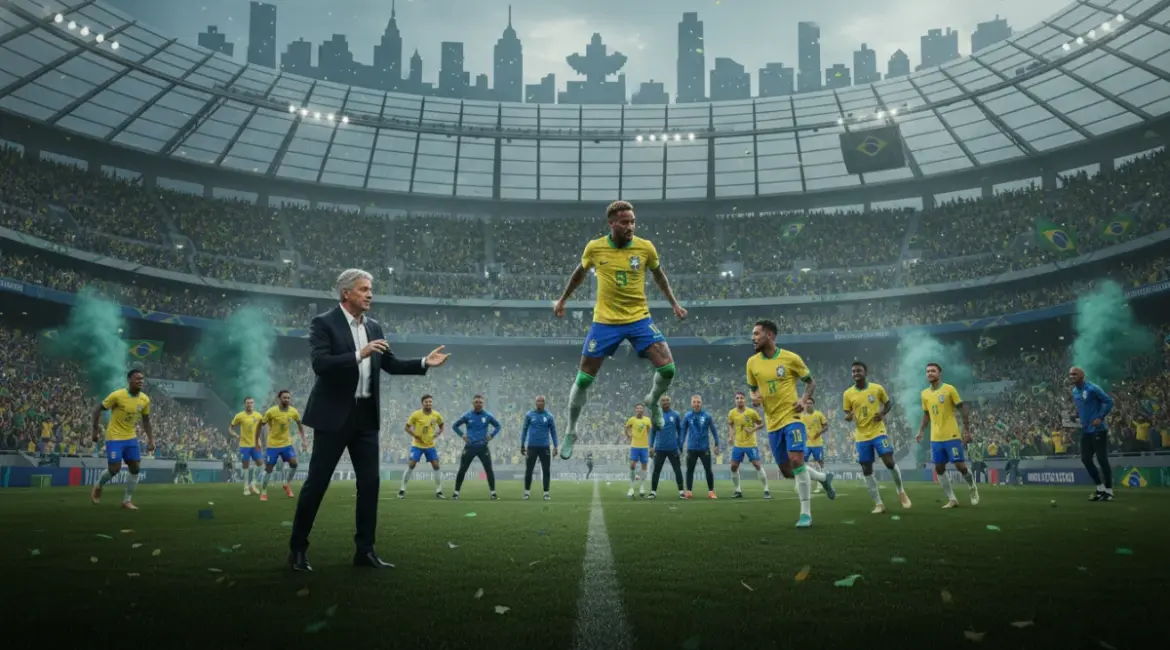
Brazil arrives at the 2026 World Cup with the same expectation that follows every major tournament: anything short of a title will feel incomplete. Carlo Ancelotti now carries that burden into his first global event as head coach, and his final 26-man selection is designed to blend calm experience, elite attacking talent, and enough flexibility to survive the pressure of a long knockout run. The roster that emerges from the initial 55-player pool is less about experimentation and more about solving a simple question: which players give Brazil the best chance to end a 24-year wait?
The answer appears to start with a strong spine. Alisson remains the clear first-choice goalkeeper, Marquinhos anchors the back line, Casemiro provides control in midfield, and Vinicius Junior leads the attacking identity. Around that core, Ancelotti has had to balance form, fitness, and availability, especially after several injuries forced the staff to rethink the final shape of the squad.
The shape of Ancelotti’s first tournament roster
This will be Ancelotti’s first World Cup as Brazil manager, and the moment comes after a long club career filled with trophies across Europe. He inherits a team that has not lifted the trophy since 2002 and has repeatedly fallen in the quarterfinals since then. That history explains why the current squad is being judged not only on talent, but also on whether it can finally handle the weight of expectation that has followed the Selecao for more than two decades.
In practical terms, the list looks built around reliability. Alisson and Ederson give Brazil stability in goal. Marquinhos and Gabriel Magalhaes offer a dependable center-back partnership. Casemiro, Bruno Guimaraes, and Lucas Paqueta supply the midfield balance that modern tournament football demands. Up front, Vinicius Junior, Raphinha, Matheus Cunha, and Gabriel Martinelli provide pace, movement, and enough individual quality to change tight matches.
Who looks secure, and why that matters
Several names are viewed as near-certainties because they fit both form and system. Wesley is expected to handle right back duties after Vanderson’s absence, while Alex Sandro is the leading option on the left. That kind of continuity matters in a World Cup, where defensive understanding often decides whether a favorite stays alive or goes home early.
| Area | Likely Brazil edge | Reason it matters |
|---|---|---|
| Goalkeeping | Alisson | Big-match calm and elite shot stopping |
| Center defense | Marquinhos, Gabriel Magalhaes | Leadership, positioning, and aerial strength |
| Midfield control | Casemiro, Bruno Guimaraes | Ball recovery and tempo management |
| Wide attack | Vinicius Junior, Raphinha | One-on-one threat and direct scoring power |
That structure gives Brazil a familiar tournament profile: solid enough to survive difficult spells, but dangerous enough to punish mistakes. In a short competition, that balance is often more valuable than pure star power alone.
Injuries that changed the conversation
Brazil’s selection talk has been shaped heavily by absences. Rodrygo is out after knee ligament surgery, with a recovery timeline that keeps him away for months. Estevao Willian is also unavailable because of a serious muscle injury, while Eder Militao remains sidelined by a longer-term knee problem. Each loss matters for a different reason, but together they strip away depth in attack and defense, forcing Ancelotti to lean harder on his most trusted options.
Those injuries also opened the door for one of the tournament’s biggest talking points: Neymar. His name was included in the preliminary pool even though he has not played for Brazil since October 2023, when he suffered a major knee injury against Uruguay. At 34, he is still Brazil’s all-time leading scorer, and recent reports suggest his form at Santos has kept him firmly in the discussion.
Neymar’s return and the final selection dilemma
The Neymar decision is less emotional than it appears and more tactical than nostalgic. If Ancelotti believes he can still produce in key moments, then Neymar offers something Brazil otherwise lacks: a player who can control the final pass, dictate the rhythm near the penalty area, and shift a match with a single action. If he makes the final squad, the player most likely to lose his place is Joao Pedro, despite his excellent scoring season in England.
That is the kind of difficult tradeoff tournament coaches face. Neymar’s experience and proven pedigree are obvious assets, but any selection must still account for fitness, mobility, and the speed of World Cup matches. Ancelotti’s final call will say a lot about whether Brazil wants the certainty of familiar greatness or the freshness of a younger, more straightforward attacking group.
Group C and the road out of the opening stage
Brazil’s group-stage path looks manageable on paper, which is exactly why the pressure will be intense if the performances are uneven. The team opens against Morocco at MetLife Stadium in East Rutherford, then meets Haiti in Philadelphia before closing against Scotland in Miami Gardens. Morocco is the only opponent in the group with top-tier international standing, which gives Brazil a strong chance to control its own destiny early.
If Brazil wins the group, the reward should be a Round of 32 match against one of the third-place qualifiers. That is a favorable route, but only if the team handles the first stage with discipline. In tournaments like this, a supposedly comfortable group can become dangerous very quickly if a favorite drops points or spends too long chasing form.
What Brazil will likely look like on the field
Ancelotti’s likely setup points toward either a 4-2-3-1 or a 4-3-3, both of which would fit the personnel and preserve enough defensive cover behind the attack. A possible starting group would place Alisson behind Wesley, Marquinhos, Gabriel, and Alex Sandro, with Casemiro and Bruno Guimaraes stabilizing midfield. Ahead of them, Raphinha, Lucas Paqueta, and Vinicius Junior would supply creativity and pace, while Matheus Cunha or Igor Thiago could serve as the central striker.
If Neymar is chosen, he adds another layer of flexibility. He could operate as the No. 10 behind the striker or drift into a false-nine role and free Vinicius Junior to attack space from wider areas. Either version gives Brazil a more unpredictable final third, which is exactly what elite teams need once knockout football begins.
Brazil’s 2026 campaign will not be judged by style alone. It will be judged by whether Ancelotti’s squad can turn talent into control, control into results, and results into a long-awaited title run. With a settled core, a few major selection calls, and a favorable group, the path is there. The real question is whether Brazil can finally walk it all the way to the end.